Daily Creates June 15th –26th
Something I did recently was gather data to visualize the radius between white dwarfs to their respective mass-radius ratio. To future explain we understand that white dwarfs are the compact remnant core of a star that has exhausted its fuel. Even though white dwarfs may possess a mass comparable to that of the Sun, they are significantly more compact, frequently resembling the dimensions of Earth causing them to be s highly dense overall.
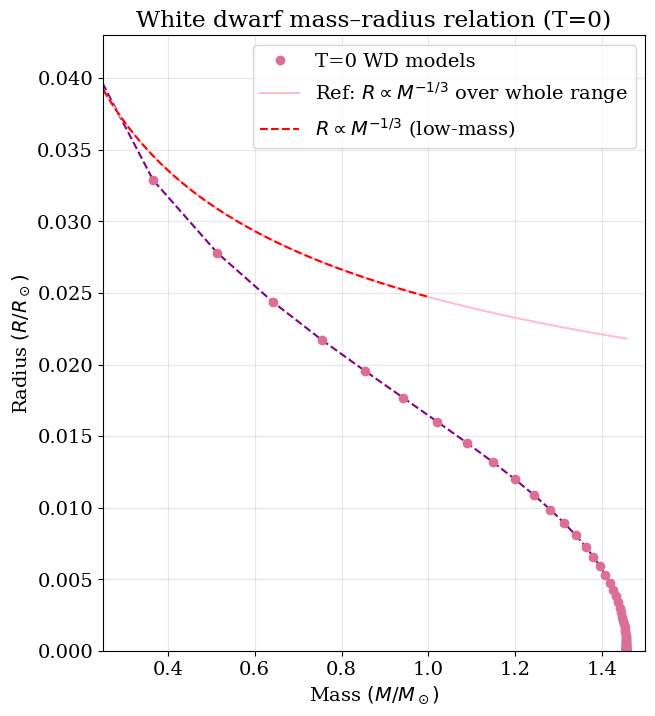
The graph illustrates the alteration in a white dwarf’s radius as its mass rises. The x-axis indicates the mass of the white dwarf in solar masses, reflecting how many times heavier it is than the Sun. The y-axis indicates the radius (solar radii) referring to its size in relation to the Sun.
What makes white dwarfs fascinating is that they don’t act like ordinary celestial objects. Typically, we anticipate that an object with greater mass will also be bigger. Conversely, in the case of white dwarfs, as the mass rises, the radius shrinks. This occurs because the substance within a white dwarf is compressed under intense pressure.
The graph’s pink dots signify various points from white dwarf models. The dashed and solid lines indicate reference trends for the expected decrease in radius relative to mass. A significant relationship presented is R∝M-1/3, indicating that as mass increases, the radius diminishes. In basic terms, denser white dwarfs are more compact.
This depiction illustrates a surprising concept in astronomy: increasing the mass of a white dwarf causes it to contract rather than expand. I selected this data because it visually links physics and astronomy, and the downward curve simplifies the relationship more than numbers can convey.